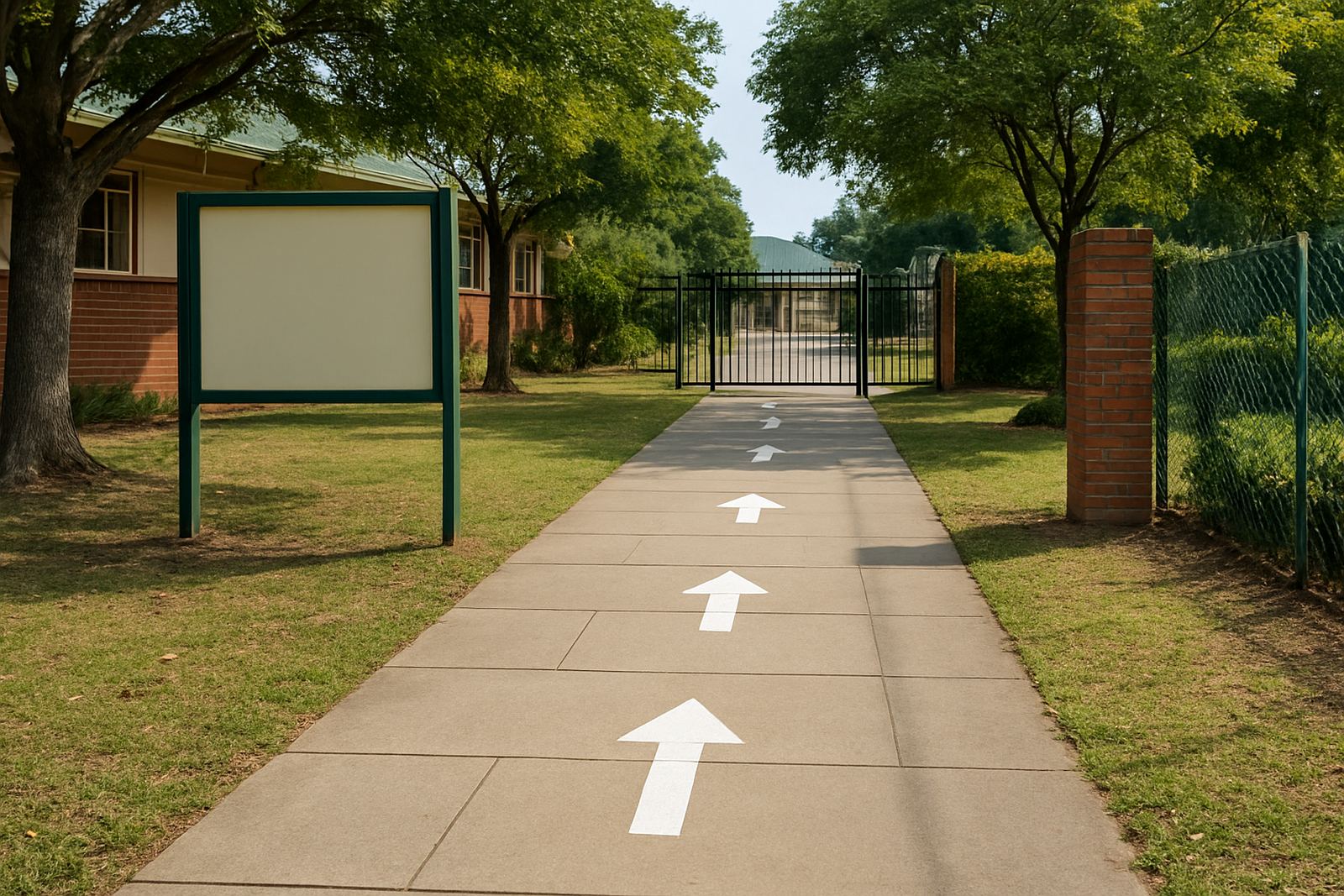
Start With the Main Entrance Message
The entrance sets the tone for the whole campus. A school needs signage that tells people exactly where to stop, where to enter, and where to go next. That usually starts with a clear school name sign at the gate, followed by visitor instructions, drop off points and office directions. If the first sign is hard to read from a moving car, it is not doing its job.
In Briardene, Durban North and across eThekwini, many schools deal with busy roads, taxis, scholar transport and early morning queues. Entrance signs must be large enough to read at a distance, and strong enough to stay neat through wind, summer rain and coastal humidity. For many campuses, a combination of cut vinyl lettering, printed panels and a light box near the road works well for visibility day and night.
- School name and crest or logo at the gate
- Visitor entrance and security point
- Drop off and pick up area markers
- Office or reception direction for parents
- Parking rules for staff and visitors
Safety Signage Keeps Movement Controlled
Safety signs are not just for workshops or factories. A school campus has pedestrian crossings, playground areas, vehicle routes, sports zones and emergency exits that all need clear direction. During busy start and end times, signage helps prevent learners from crossing in the wrong place or walking through delivery access points. That can make a real difference on a crowded property.
Good safety signage should use simple words, clear arrows and colours that stand out. Where there is a risk of drivers missing a sign, reflective film or a light box can improve visibility. In outdoor areas, signs must hold up against washing, sun fade and repeated handling, especially where learners pass every day.
- No entry signs for restricted areas
- Speed limit signs for internal roads
- Pedestrian crossing markers
- Fire assembly point signs
- Emergency exit direction signs
Directional Boards Should Reduce Questions at the Gate
Visitors should be able to find the office, hall, sports field and classroom blocks without asking staff for help every five minutes. Directional signage saves time and reduces traffic at the front entrance. It also helps new parents, suppliers and relief teachers move around the campus without stress. A well planned sign set can cut down confusion and keep the school day moving.
For larger campuses, directional boards are often best when placed at decision points, not only at the entrance. That means along internal roads, at stairs and at junctions between blocks. If the campus has multiple levels, the signs should be placed at eye level and sized so they can be seen from a distance. Simple wording works best, and too much text usually gets ignored.
- Office, reception and admissions directions
- Classroom block names or numbers
- Hall, library and computer room signs
- Toilet directions for boys, girls and staff
- Sports field and tuckshop markers
Materials That Stand Up to Durban Weather
Durban schools need signage that can handle strong UV, salty air and heavy summer rain. Outdoor panels made from Chromadek, Perspex or ABS are common choices because they keep their shape and are suitable for regular exposure. Where the sign needs extra visibility, a light box can be useful for gate walls or roadside positions. Vinyl graphics work well for doors, windows and internal directions.
Window frosting and contra-vision are also useful on school property, especially for administration areas, medical rooms and staff offices. Frosting gives privacy without making glass feel closed off, while contra-vision allows branding on the outside and some visibility from the inside. For schools that want a neat, orderly look, these finishes can help tie the whole campus together.
Maintenance matters too. Signs near the coast often need cleaning, tightening or replacement sooner than inland sites. A practical plan should allow for occasional refurbishment, removals and maintenance visits so the campus does not start looking tired after a few seasons.
Where Schools Usually Need the Most Signage
Every school has its own layout, but the same problem areas keep showing up. The gate, reception area, parking bays and learner movement routes usually need the clearest signs. If a campus has more than one access point, each entrance should have matching instructions so there is no confusion when visitors arrive from different sides.
Here are the areas that are most often missed during planning:
- Security gate and visitor signing in point
- Admin block and admissions office
- Parking bays for staff, visitors and disabled access
- Hall, tuckshop and toilet routes
- Sports grounds, swimming pool and assembly area
- Service yard and delivery access
It also helps to think about the day-to-day flow of learners. A sign that works for a parent in a car may not be enough for a child walking across the campus. That is why schools often need a mix of big external signs, smaller wall signs and directional markers at walking height.
A Durban North Example That Shows the Difference
Picture a school in Durban North with one busy front gate, a second access point for deliveries and a long internal driveway. In the morning, parents arrive from different streets, staff park in one area and learners move across the property in groups. Without clear signage, the office team ends up answering the same questions again and again. Where do we sign in? Which way to the hall? Is this the drop off point?
After a proper signage plan, the gate carries the school name and visitor instructions, the driveway has speed and pedestrian signs, and the office block is easy to find from the entrance. Directional boards point to the hall, sports field and staff parking. A small light box at the road helps with evening events and winter afternoons when light drops quickly. The change is not dramatic in one moment but the campus feels calmer, and visitors move through it with less confusion.
That kind of result comes from planning the sign locations before anything is made. Site surveys, artwork setup, fabrication and installation all matter, because a school sign has to work in real conditions not just on paper.
Plan for Compliance, Visibility and Future Changes
School signage should support safety and order, but it also needs to leave room for future changes. A campus may add a new block, rename a room or shift parking as enrolments grow. It is easier to plan for modular signs and replaceable panels than to start over each time the layout changes. That saves time and helps keep costs under control.
Before sign production starts, schools should check that the wording is clear, the placement is sensible and the message suits the people who use the property every day. In many cases, the best signage is not the biggest sign. It is the one that gets seen at the right time and answers the right question. For schools in eThekwini, Umhlanga, Pinetown and the KZN North Coast, that practical approach keeps things orderly even when the campus is busy.
When the signs are well thought through, entrance areas feel more welcoming, movement is safer and visitors know exactly where to go. That is the standard a school should aim for.