Start With the Weather Your Sign Will Face
In Durban North and along the coast, a sign is not only carrying a message, it is working against heat, UV and moisture every day. A shopfront sign facing north gets more direct sun, while a sign near the beachfront or harbour side has to handle salt in the air and stronger wind loads. That means the best-looking material on paper is not always the right one on site.
Before choosing anything, look at three things: where the sign will be mounted, how far it sticks out, and whether it will be exposed to sun all day. A flat wall sign under an awning can use a lighter build than a freestanding pylon or a sign on a windy corner. If the site gets afternoon sun, heat buildup can also affect inks, adhesives and plastics.
- Direct sun: prioritise UV-stable print films, laminates and boards
- Coastal air: choose corrosion resistant fixings and sealed edges
- Wind exposure: use stronger frames, thicker boards and proper anchoring
- Rain and humidity: avoid materials that swell, warp or peel at the edges
Vinyl, Print Film and Lamination for Shorter Runs
Vinyl is one of the most useful outdoor materials because it works for cut lettering, logos and printed graphics. For temporary promotions, directional signs or seasonal campaigns, vinyl on a smooth surface can be a cost-effective option. For a vehicle or shopfront window, the print must be matched to the right adhesive and then protected with a good laminate.
In strong sun, laminated print lasts longer and keeps colour better than unprotected media. A matte finish can reduce glare on windows, while gloss can make colours pop more for retail displays. For outdoor use, the key is not only the print itself but the edge detail. Poorly trimmed edges or weak adhesion will lift faster in humidity, especially where there is condensation in the early morning.
- Use cast or premium vinyl for complex curves and longer life
- Use print lamination to protect against UV, scratches and cleaning chemicals
- Use frosted or contra-vision film where privacy is needed but daylight must stay in
- Allow proper curing time before full weather exposure
Chromadek, Aluminium and Other Metal-Based Boards
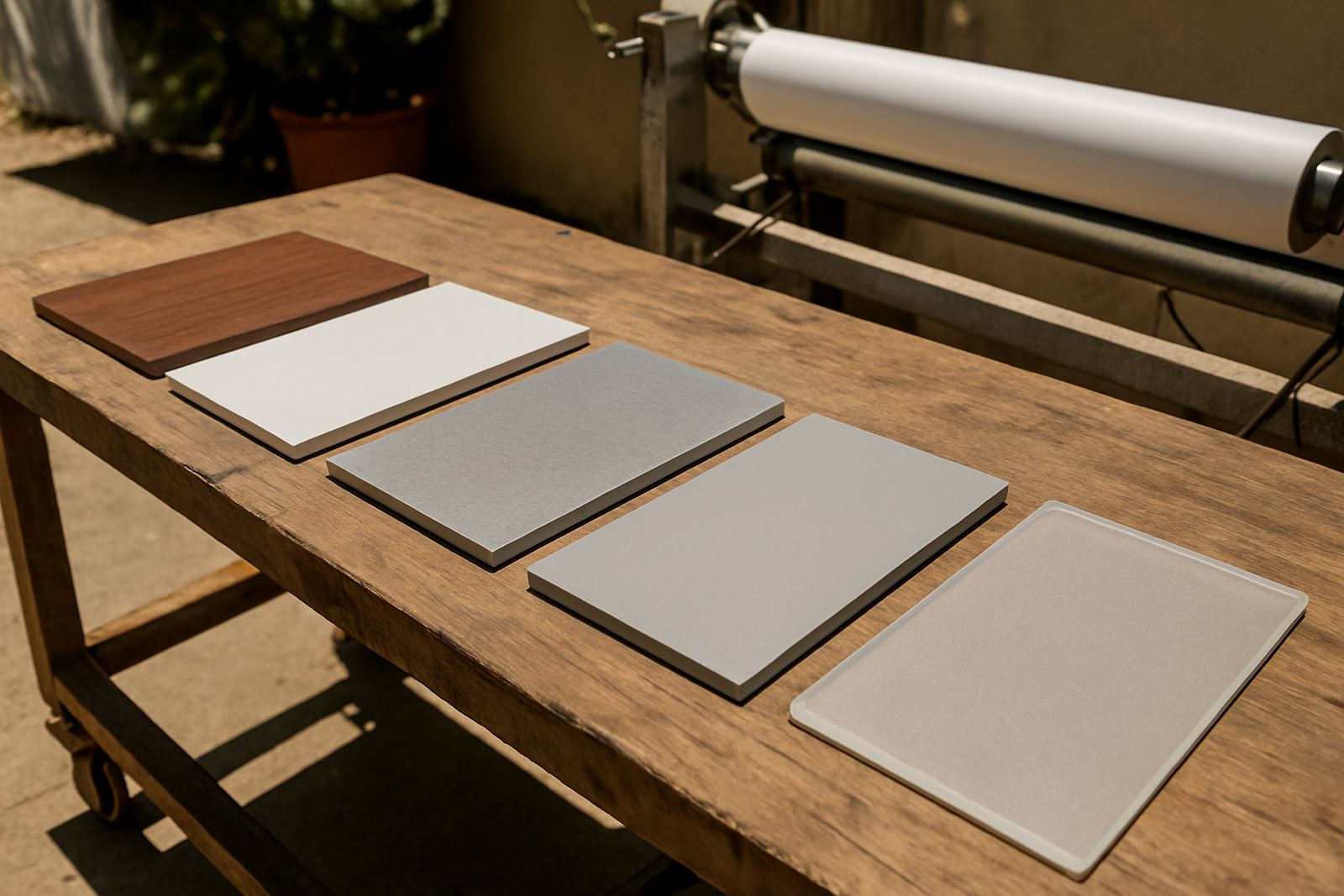
For longer-term outdoor signs, metal-based boards are often the practical choice. Chromadek is widely used because it has a pre-painted steel surface that is suited to printed graphics, panel signs and directional boards. It gives a neat finish and is generally stronger than many plastic boards when the sign needs to hold shape outdoors. Aluminium is also useful where weight matters or where corrosion resistance is a priority.
On coastal sites, the supporting structure matters as much as the face material. Steel frames need proper coating or galvanising, and all fasteners should be chosen with corrosion in mind. If the sign is near the sea, untreated fixings can stain, weaken or leave rust marks around the panel. That is a common issue in places like Umhlanga and the KZN North Coast, where the sign may look fine at install and then start showing edge wear later on.
- Best for long-term shopfront panels, directional signs and site boards
- Works well for flat surfaces that need a clean, professional look
- Needs sealed edges, solid mounting and suitable corrosion protection
- Good choice where regular cleaning and maintenance are expected
Perspex, ABS and Light Box Faces for Visibility
Where a sign must stand out at night or in low light, translucent materials become more important. Perspex is often used for illuminated faces, logo panels and branded inserts because it can transmit light evenly. ABS is useful for formed sign parts, raised lettering and lighter fabrication work, especially where a clean edge and shaped detail are needed.
Light boxes are effective for retail, healthcare and service businesses that operate after sunset or need visibility during load-shedding. In those cases, the front face must be strong enough to handle heat from the fittings and any weathering from the top edge. If the sign is installed high above street level, access for maintenance should also be planned early. A failed face or a flickering light source becomes expensive if every repair needs access equipment.
- Use translucent faces where internal lighting is required
- Check thickness and rigidity so the face does not bow in heat
- Plan access for lamp or LED replacement and cleaning
- Use materials that stay clear and do not yellow quickly in sun
Wind, Mounting and Fixings Matter as Much as the Board
Many sign failures start with the mounting, not the material itself. A board that is fine on a calm inland site may fail on a corner in Pinetown or near an open coastal road if the frame is too light. Wind can work under edges, loosen fixings and create vibration that shortens the life of the whole structure. That is why installation details need to match the site, not just the artwork.
When choosing outdoor material, think about the full assembly: panel, frame, backing, fixings and sealants. A sign with cut-out lettering may need spacers and stronger anchors than a flat printed board. Large panels should also allow for expansion and contraction in hot weather. If the panel is fixed too tightly, it can buckle or crack over time. A proper site survey helps avoid these problems before fabrication starts.
- Match sign size to the wind exposure on the site
- Use the correct anchors for brick, concrete, steel or cladding
- Allow for thermal movement on larger panels
- Seal penetrations to keep moisture out of the wall and frame
A Durban Example: Choosing Materials for a Coastal Retail Front
A practical example is a retail frontage in Umhlanga with strong afternoon sun, salt air and foot traffic close to the glass. The main fascia panel could use a printed and laminated Chromadek face for colour stability, while the window area uses contra-vision film for privacy without blocking visibility from inside. If the store trades into the evening, a light box or illuminated logo panel gives the frontage a better chance of being noticed after dark.
For a site like this, the decision is not about one material doing everything. It is about using the right material in the right position. The outer panel needs durability, the window film needs controlled visibility and the illuminated section needs service access. That combination usually performs better than one oversized sign trying to handle every job on its own. In coastal work, less complication often means less maintenance.
For businesses across eThekwini, from Briardene to Westville, Phoenix and Ballito, the best sign choice usually comes down to the site conditions first, then the brand look. That order matters because a sign that fades, rusts or peels early ends up costing more than the stronger option chosen at the start.