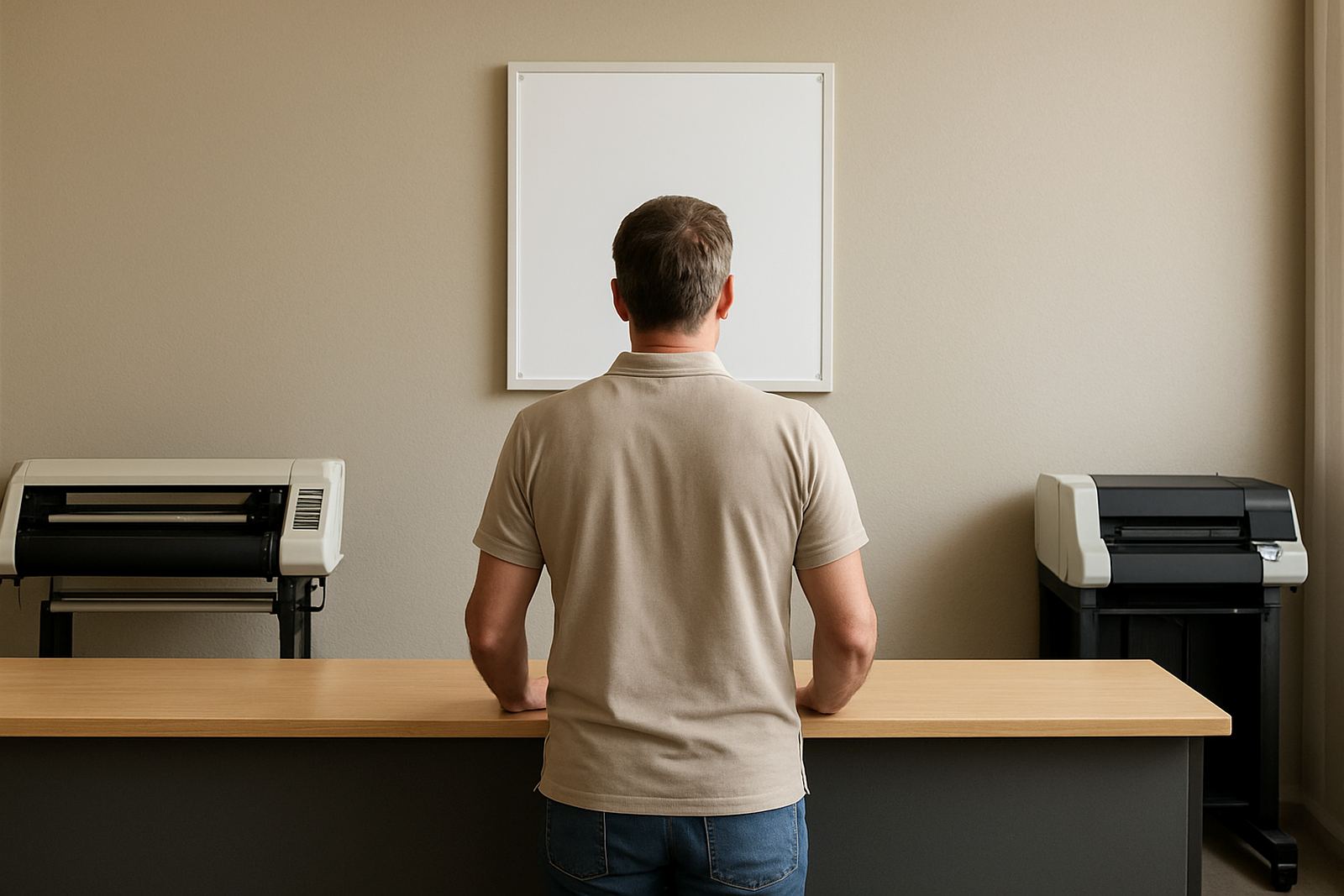
Why the reception area sets the tone
When someone walks into your offices, showroom or medical practice, the reception area tells them what sort of business you run before a single conversation starts. A neat sign behind the counter or on the feature wall gives visitors confidence that the same care goes into your service.
In Durban North, Umhlanga and across eThekwini, many premises have mixed lighting, glass fronts and air-conditioned interiors that create reflections. If the reception sign is too small, poorly spaced or made with the wrong finish, it can disappear into the background. A clean sign with the right contrast helps guide the eye and gives the room a proper focal point.
Walk-in clients also notice whether the sign feels intentional. A laminated print that is straight, well trimmed and fixed flush to the wall says more than a rushed sign with lifting edges or uneven lettering. That detail matters in legal offices, medical rooms, finance businesses and customer-facing counters where trust is built from the moment a visitor arrives.
Choosing the right material for a front-of-house sign
Reception signs can be made in different ways depending on the wall surface, lighting and the look you want. For some spaces, a plain printed panel is enough. For others, raised lettering or a light box gives better presence after hours or in darker interiors.
At BP Signs we work with vinyl cutting, digital printing, Chromadek, Perspex and ABS sign fabrication, so the finish can be matched to the site rather than forcing one solution everywhere. A board in a dry interior may need a different approach from a sign that sits near a doorway where humidity and condensation are common.
- Perspex: neat for logos, layered signs and polished reception walls.
- ABS: useful for shaped lettering and clean internal branding.
- Chromadek: practical where a tougher printed panel is needed.
- Vinyl and print: suitable for logos, wording and directional messages.
- Light boxes: helpful in low light or where evening visibility matters.
The best choice is often the one that balances appearance, maintenance and the reality of the room. A reception sign should look sharp on day one and still hold its shape and colour after months of use.
Finish and fit are what visitors actually notice
The difference between an average sign and a proper reception feature is usually found in the finish. Clean edges, accurate spacing and secure fixing matter more than most people realise. If a sign bows, peels or sits slightly off level, visitors see that immediately.
Our team handles site surveys, artwork setup, print lamination, sign fabrication and installation, so the sign is measured and fitted with the location in mind. That is especially useful in older buildings around Pinetown, Westville and central Durban where walls are not always perfectly flat and existing finishes can make mounting difficult.
Reception signs also need to work with the rest of the room. If the counter is dark wood and the wall is a light colour, a high-contrast sign may be best. If the space already has busy textures, a simpler sign usually reads better. The aim is clarity, not clutter.
- Check the wall surface before finalising the material.
- Allow enough clear space around the sign for it to breathe.
- Match the sign size to the viewing distance from the door and seating area.
- Use lighting that does not throw harsh glare across the face of the sign.
A local example from a Durban North reception
We often see businesses in Briardene and Durban North updating reception areas after moving into a new unit or refreshing an older premises. One common job is replacing an outdated board with a cleaner sign that matches the current logo and interior colours. The difference can be immediate.
For example, a business with glass frontage and a narrow waiting area may benefit from a frosted vinyl treatment on the glass, plus a simple sign above the counter. That combination gives privacy, reduces distractions and still keeps the brand visible. In a busy area where clients arrive throughout the day, it also helps people know they are in the right place without needing to ask twice.
Across Umhlanga, Tongaat, Verulam and the KZN North Coast, many reception spaces need signs that work in both daylight and under indoor lighting. A good solution must hold up to repeated cleaning, daily contact and the occasional knock from bags, trolleys or delivery boxes. That is why the fixing method matters as much as the face of the sign.
When a reception sign is done properly, it becomes part of the room rather than an extra item hanging on the wall. It supports the brand without shouting for attention.
Practical points before you order a reception sign
Before you commit to a design, it helps to think through how the space is used. A reception sign is not only about looks. It must be easy to read from the entrance, suitable for the wall or panel it will sit on, and practical to maintain.
If your premises is affected by load-shedding, consider whether you need a sign that still works in low light or a design that stays readable without relying on overhead lighting. In some offices, a light box or reflective detail can make all the difference. In others, a plain sign with strong contrast is enough.
- Measure the wall and nearby furniture before choosing the final size.
- Confirm whether the sign will sit on painted plaster, board, glass or tiled surfaces.
- Decide if the sign needs to be removable for future refits or maintenance.
- Ask whether the design needs frosting or contra-vision on adjacent glass.
- Check municipal or building rules if the sign is visible from shared common areas.
It also helps to think ahead. If you may move offices or rebrand later, a modular sign or removable system can reduce waste and save time. That sort of planning is useful for growing businesses in fast-changing commercial areas.
How BP Signs handles reception sign projects
We work from Briardene, Durban North and make and install signs across eThekwini, Umhlanga, Pinetown and the North Coast. Our team includes Bongani Patrick Zulu, Nokuthula Mkhize, Sashen Naidoo, Anele Dlamini, Priya Govender and Lindokuhle Khumalo, each handling a part of the process from artwork to installation.
Reception jobs often start with a site survey so we can check the wall, light levels and fixing points. From there we prepare the artwork, produce the sign, laminate where needed and install it neatly on site. If the front area also needs window frosting, directional signs, a small light box or a matching brand refresh, those can be handled at the same time.
We also assist with sign refurbishment, removals, maintenance visits and shopfront installation when an existing reception area needs a fresh start. Clients usually reach us through the enquiry form on our contact page, which is the easiest way to get the process moving.
A reception sign should do more than fill a wall. It should make the space feel organised, credible and ready for visitors the moment they step in.