A sales site that needed clear roadside presence
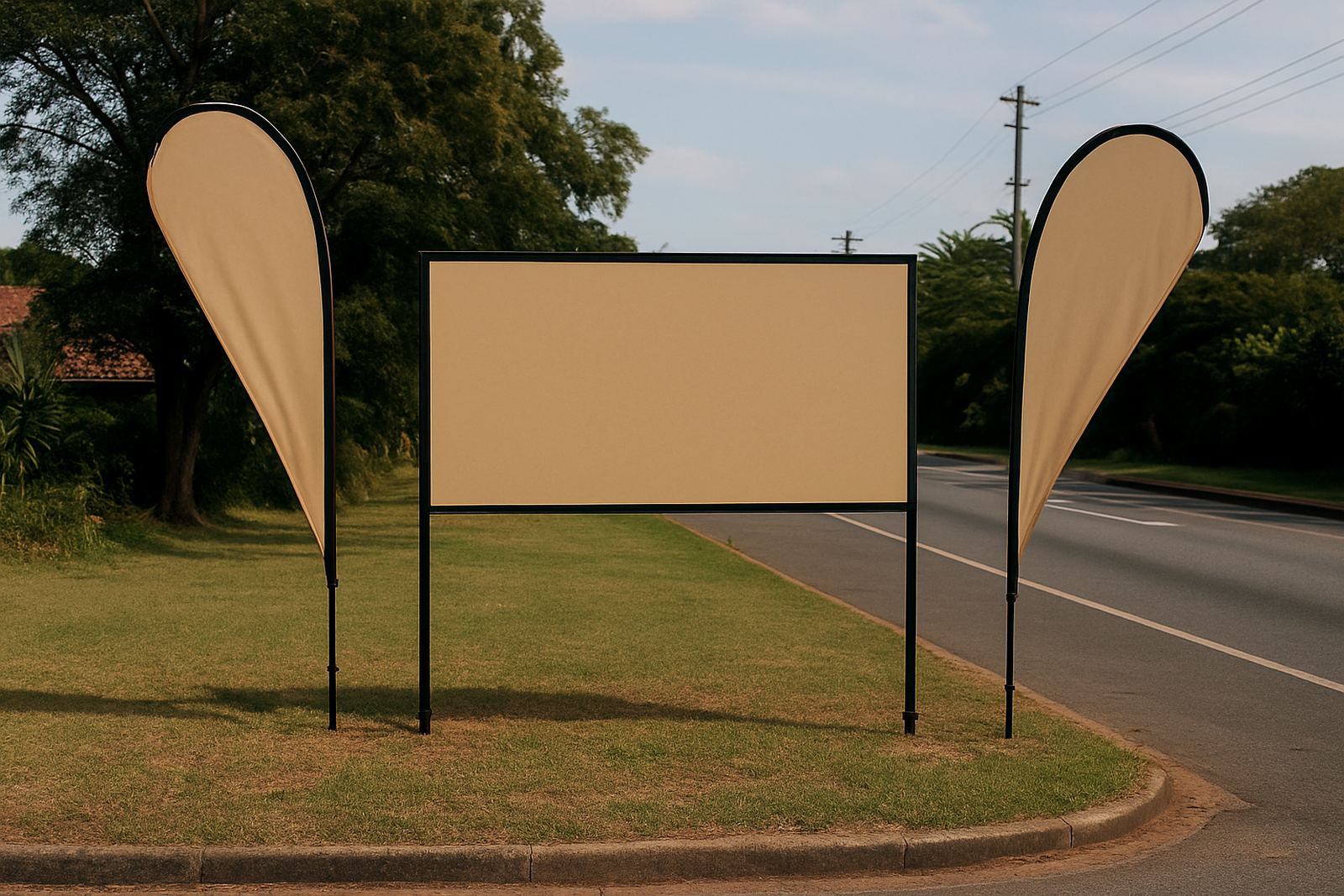
The brief came from a property development team in the uMhlali area who needed the site to stand out from the road and stay readable from a moving vehicle. The focus was not just one sign, but a set of items that worked together: main property boards, branded flags and directional signage to lead people from the access road to the sales point. The site was close enough to the coast for salty air and strong wind to matter, so the materials had to hold up without looking tired after a few weeks.
The development was active while marketing was happening, which meant we had to plan around delivery trucks, workers on site and limited space to stop and install. Visibility was important, but so was keeping the layout tidy and safe for pedestrians and vehicles. We also had to match the sign positions to the actual movement pattern on site, because a good board in the wrong place still misses the point.
What the client needed and what we had to avoid
The client wanted a clean property marketing setup that could be read quickly by passing traffic and still make sense for first time visitors. The boards needed strong contrast, the flags had to move enough to catch the eye, and the directional signs had to be placed where drivers could react in time. The job also had to be done without blocking access or leaving loose material around the site entrance.
There were a few constraints to work around. The road edge was exposed to wind, so the fixing method needed proper holding power. The area also gets bright sun, which can flatten colours if the print and lamination are not right. We kept the message short, used direct arrows and chose sizes that could be seen from a distance without crowding the artwork.
- High roadside visibility for passing traffic
- Wind exposure near the coastal corridor
- Live site access with vehicles moving in and out
- Short, clear messaging for quick reading
- Durable finishes for sun and rain
Boards, flags and directional signs supplied
For this project we supplied a mix of fabricated and printed items built for outdoor use. The main boards were made in weather-resistant sheet material with full colour print and protective lamination. The directional units used clean arrow layouts, while the flags added height and motion so the site could be spotted sooner from the approach road. Everything was produced in our Briardene workshop before installation.
Key specifications were selected around the site conditions and the distance from which each item needed to be read. The property boards used bold type, simple directional cues and strong colour contrast. The flags were sized to remain visible above parked vehicles and boundary lines, and the posts were set for steady holding on ground that can be uneven after rain. We also made sure the print finish would cope with coastal humidity, not just the first week of install.
- Roadside property boards with full colour print
- Directional arrows for site entry guidance
- Branded flags for height and movement
- Outdoor lamination for colour protection
- Site-safe mounting and fixing for exposed conditions
How we handled production and installation
Our team started with a site survey to check road visibility, access points and the best fixing positions. From there we handled artwork setup, large format printing and fabrication in-house. The production sequence was kept tight so the printed panels, poles and fixing hardware were ready together. That helped avoid delays and meant the install team could move through the job in one coordinated visit.
Installation was planned around traffic flow and site activity. The boards were aligned so they could be seen at the right angle for drivers entering from the main road, and the directional signs were placed at decision points rather than too early. The flags were positioned where they could move freely without fouling on trees, wires or access routes. It was a practical install and the finish had to look neat even from close range. Nothing fancy, just correct placement and firm fixing.
- Site survey and layout check before production
- Artwork setup with concise property messaging
- Print, lamination and fabrication completed in-house
- Installed with attention to traffic approach lines
- Final positioning checked against the actual site flow
Timeline and working rhythm over two weeks
The project moved through a two week window from survey to final installation. The first week was used for measuring, confirming artwork and preparing the sign set. The second week covered print production, fabrication, delivery and install. That schedule gave enough time to deal with small changes in layout and still keep the launch date on track.
Because the site was live, timing mattered almost as much as the signs themselves. We coordinated the installation to avoid peak movement periods and kept the on-site team lean. That reduced disruption and allowed the client to continue with development work while the marketing signage was being fitted. The result was a property frontage that was ready for viewing without slowing the site down. A simple job, but it needed proper sequencing.
What changed once the signage was in place
Once the boards and flags were up, the site became easier to spot from the road and easier to navigate once people had turned in. The directional signs cut down on confusion at the entrance, and the property boards gave the development a more organised presence from the outset. For a sales site, that matters because first impressions often happen before someone has even stopped the car.
The client had a clear visual package they could keep using across the campaign, and the layout worked well in the bright coastal light. The print stayed readable and the colours held up properly after the first stretch of sun and wind. If we were doing the same project again, we would keep the same approach: short copy, strong contrast, weather-aware materials and careful sign positioning. That is what makes roadside marketing work here.
- Better roadside visibility for passing traffic
- Clearer wayfinding for visitors and prospects
- More polished presentation for the development
- Durable result in a coastal environment
- Simple layout that can be reused on future phases
What we would repeat on the next development job
For another property board project in uMhlali or anywhere along the KZN North Coast, we would follow the same process with only small changes based on the site. Early survey, clean artwork, strong material choice and proper fixing are the parts that save time later. It also helps to keep the message short enough for road reading, because people do not have long to absorb details at speed.
BP Signs handles these jobs from Briardene, Durban North and installs across eThekwini, Umhlanga, Pinetown and the North Coast. For development marketing, the best results come from a sign plan that is practical from day one and built for the weather conditions on the ground. That is what we delivered here, and it is the same approach we use on similar property sites.
Key facts
| Project | uMhlali property boards and directional signage |
|---|---|
| Client type | Property development marketing team |
| Location | uMhlali, KZN North Coast |
| Scope | Roadside boards, flags and wayfinding signs |
| Turnaround | 2 weeks from survey to install |
| Key materials | Printed outdoor panels, lamination, posts and fixings |